




Filtration skids
Veenbrink RVS produces and validates various filtration skids, including microfiltration and ultrafiltration units. Microfiltration (MF) and ultrafiltration (UF) are similar in many ways. Both systems use membranes to filter contaminants from the medium. The membranes and in particular the pore size of those membranes determine the extent to which the medium is filtered. This is also where we find the most important difference between MF and UF: the pore size is larger in microfiltration than in ultrafiltration. Pore size determines how many particles can pass through. This is also the reason why a microfiltration unit is often followed by an ultrafiltration unit. Veenbrink RVS’s microfiltration and ultrafiltration skids are delivered completely turnkey. By using an integrated approach to mechanics, electrical systems, instrumentation and automation, the skids can be designed, produced, validated and installed as plug-and-play systems.
CIP skids
Hygiene plays an important role in the design and production of process equipment in both the pharmaceutical and food industries. Prevention is always better than the cure, but we cannot always avoid the need to clean equipment. Various cleaning methods can be applied, such as Clean In Place (CIP), Sterilisation In Place (SIP) and autoclaving. The most common way to clean process equipment locally is CIP. CIP installations can contain various cleaning cycles: pre-rinsing, cleaning with lye and acid, intermediate cleaning with demineralised water, cleaning with detergent and disinfectant, or otherwise. The size of the process tanks to be cleaned can also vary. Also, it is important to know whether tanks need to be cleaned simultaneously. CIP installations can be operated manually or automated using pre-programmed formulas and operation via the Human Machine Interface (HMI). With automated CIP skids, communication with other systems, such as the process equipment to be cleaned, is of course taken into account. Although CIP systems are custom-made, they often contain a number of key components: a CIP tank, pump, flow meter, temperature transmitter, conductivity sensor, heater, and associated piping.
Buffer preparation skids
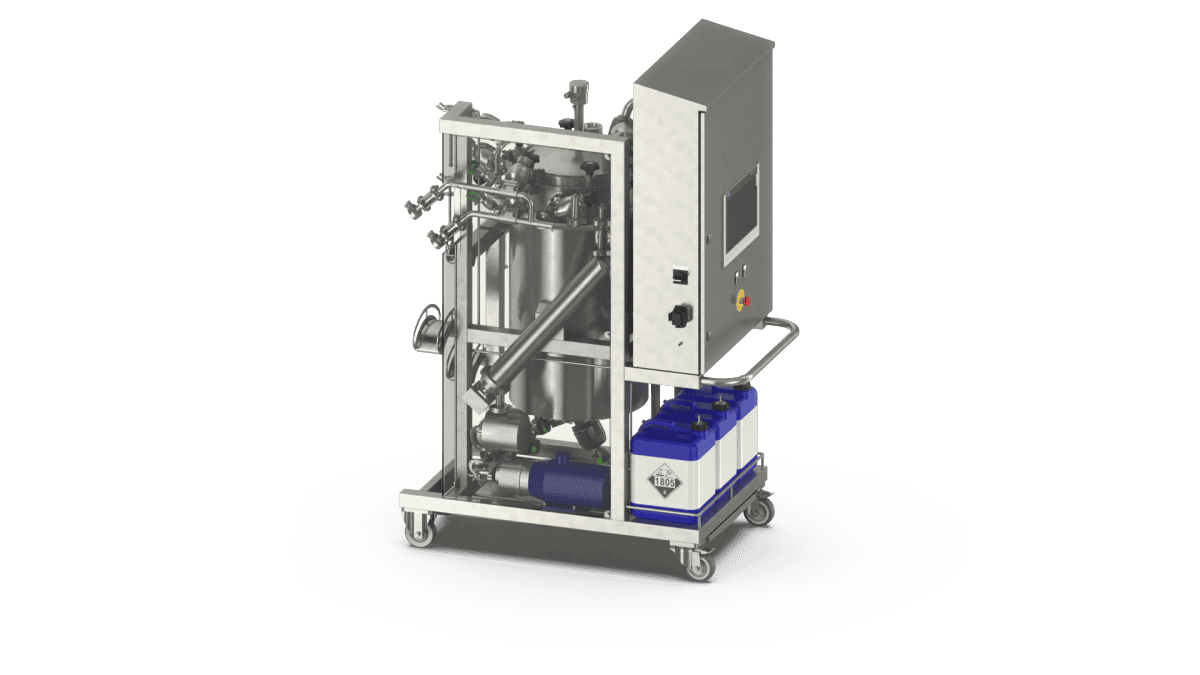
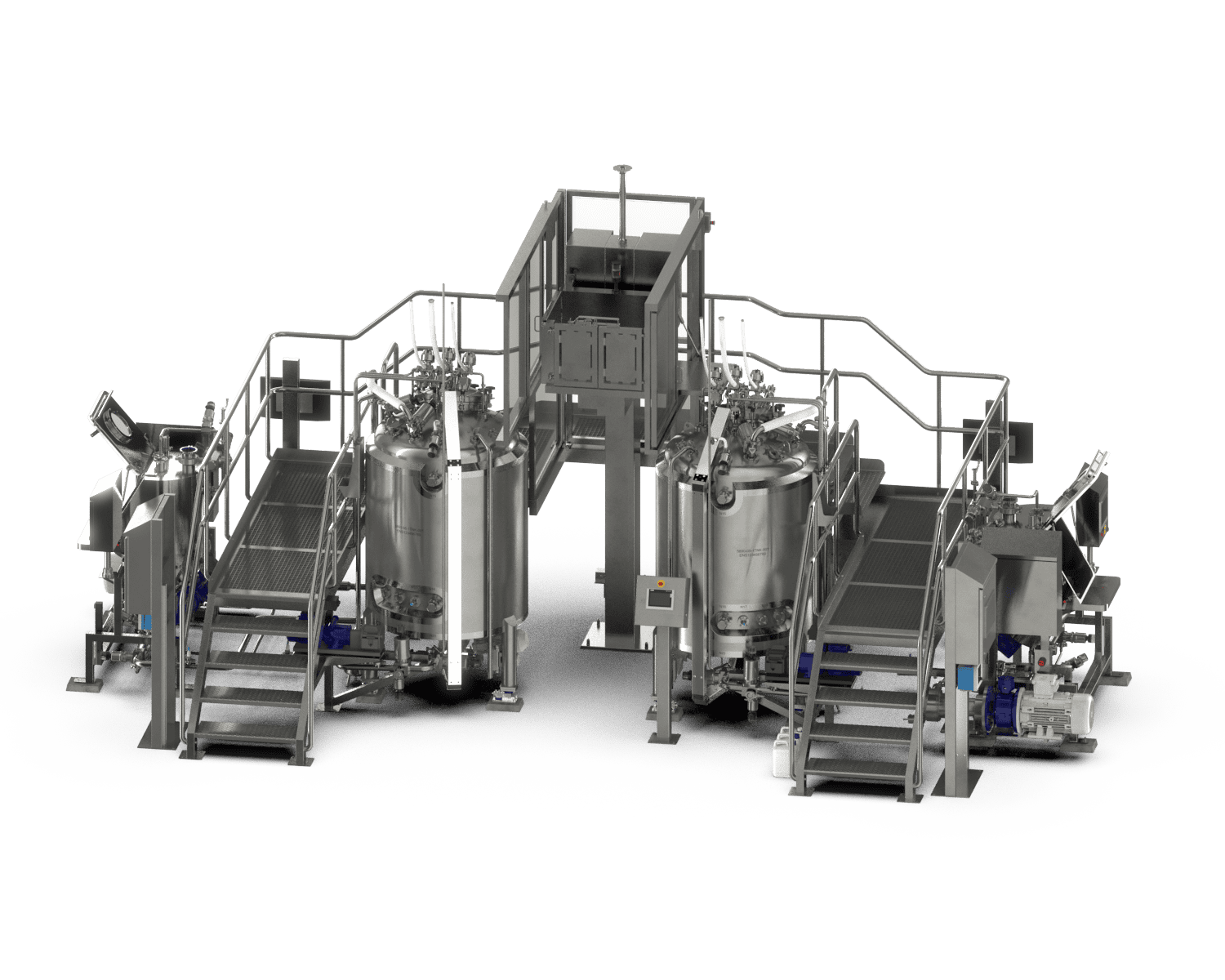
In biopharmaceuticals, buffer preparation skids are used to produce products that feed the microorganisms in the subsequent fermentation process. Buffer preparation skids are often filled with WFI (Water For Injection) and other raw materials. Powders and/or solids are also often added to the skid: manually via a lift and the manhole, or via a separate dosing unit, where the powders and/or solids are ground and pumped around. For powder dosing, production often takes place within ATEX classified zones. Safety and ergonomics are therefore of great importance. Hygiene and cleanability also play an important role: our engineers take this into account when selecting valves, instruments, and accessories such as agitators, pumps, heat exchangers, and sampling valves. The final media are often packed from the larger buffer preparation skids into smaller buffer vessels, containers or bags.
Dilution skids
Automated chemical dilution systems control the combining of two liquid streams to achieve a desired final solution concentration level. This allows users to purchase higher concentration chemicals and dilute them independently for the desired process. Dilution skids may pertain to disinfection media such as acids or sodium hydroxide. This involves diluting acid or sodium hydroxide with WFI (Water For Injection). The dilution skid is supplied from large storage silos with both concentrated acid or sodium hydroxide as well as WFI. By mixing, heating or cooling, and circulating the solution, the desired concentration is ultimately achieved based on the pH value or conductivity. The diluted acid or sodium hydroxide can then be used, for example, to clean various process equipment.

Bioreactors
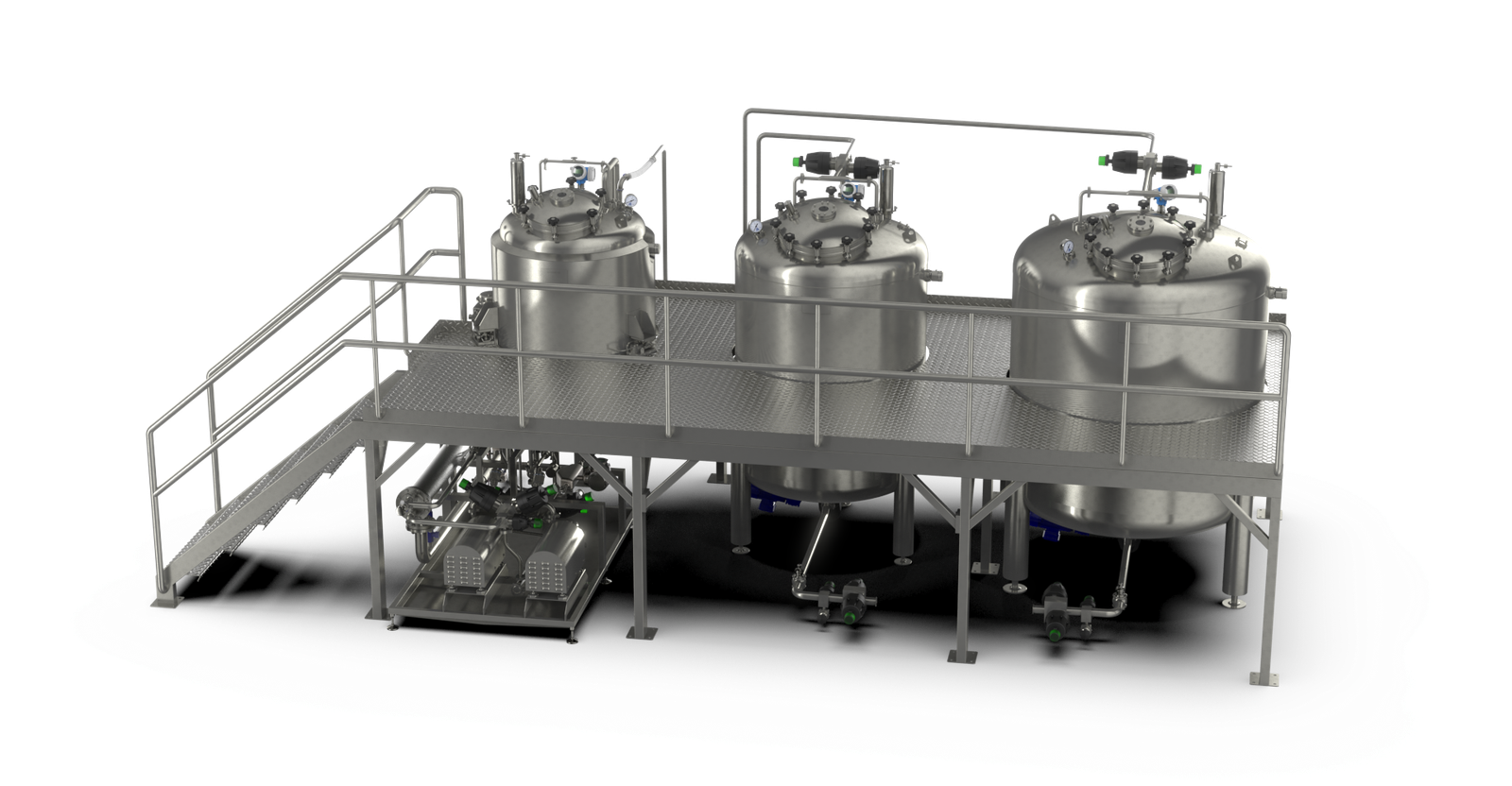
Veenbrink RVS supplies bioreactors in various volumes. The bioreactors are characterised by a fermentation process. This is a biological process in which microorganisms are introduced into an ideal environment. By very precisely controlling the conditions in the reactor, such as pH value, temperature, pressure and oxygen content, the growth and activity of the micro-organisms are optimised. The cells provide for the production of nutrients for the finished product. The life cycles of fermentation batches are often uniform. Cells exposed to the controlled conditions at the beginning of the process must first acclimate to the new environment. Once the cells become accustomed, they begin to double at a consistent rate. When cells secrete a certain amount of waste, cell growth stagnates: the number of cells that die increases and the number of cells that double decreases. Once the fermentation process is at its peak, the harvest takes place. Harvesting can be done in different ways:
• ISF (Internal Spin Filter) harvesting
• ATF (Alternating Tangential Flow) harvesting
With an ISF (Internal Spin Filter), the harvest is obtained by using a spin filter inside the reactor: a harvest tube collects all cell-free media present in the spin filter. Because the filter has a specific mesh size, it ensures that cells remain outside the filter and the harvesting zone and can continue to grow as long as conditions are right.
With an ATF (Alternating Tangential Flow), the cell suspension (retentate) is removed from the bioreactor using vacuum techniques. Cell-free harvest is recovered and collected by pumping the suspension back into the bioreactor through the filter housing.