



Stir or mix?
At Veenbrink RVS, we distinguish between stirring and mixing. Stirring means keeping the product moving or homogenising it by stirring it slowly. No phase transition or reaction occurs in this process. Consider powders that need to be mixed together or a cream that needs to be kept moving for optimal heat transfer with the wall. This is often applied with a high viscosity, low speed and a relatively low scale of agitation.
Mixing is at the other end of the spectrum. When mixing, a phase transition or chemical reaction does occur. This could involve dissolving a solid such as sugar in a liquid such as water, or emulsifying two liquids that are not easy to mix, such as oil and water. In this case, high speed with high shear forces is important.
Position and orientation
The positioning and orientation of an agitator or mixer determine its ultimate operation. Large gate or anchor agitators, some with scrapers, are logically placed in the middle of the tank. To prevent the medium from simply rotating, baffles are sometimes required. High-speed mixers perform best when positioned 1/10 to 1/6 of their diameter off-center. A vertical orientation is always preferred because of the construction and the direction of the relevant forces, although this is not always geometrically possible.
The geometry and operation of a mixer or agitator always depend on the geometry of the top and especially the bottom. Some processes requires a light or heavy cone, others a torispherical shape.
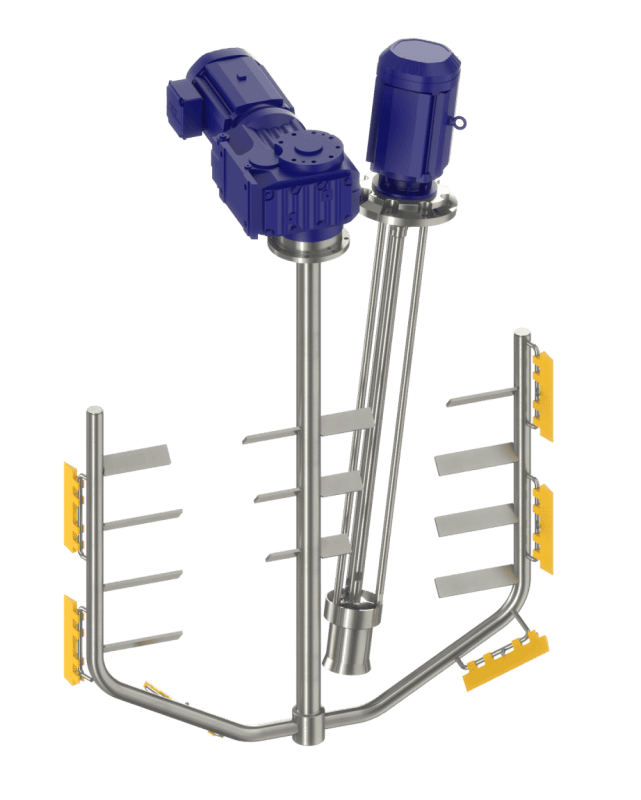
Important properties to consider are the required scale of agitation, rounds per minute, viscosity and shear force.
Impellers
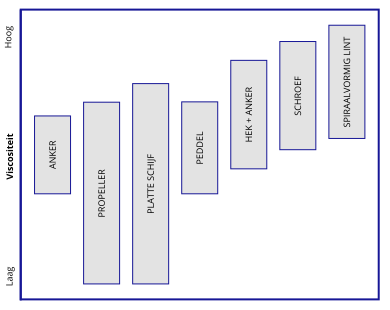
In addition to the correct design of the drive and seal, the type of impeller determines the manner in which stirring or mixing is achieved. Important properties that need to be considered are the required scale of agitation, rounds per minute, viscosity and shear force. For high shear forces, you could consider a saw blade or rotor-stator mixer. For viscous slow stirring, an anchor, gate or worm agitator will be used.
In addition, factors such as the minimum mixing level and the degree of sterility and sanitation can also be decisive. When this is important, magnetic stirrers or bottom mixers are often used.
Impellers
Hydrofoil
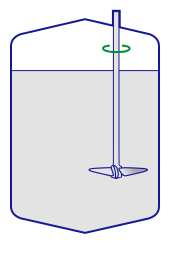
An efficient, low-shear agitator. The blade is slightly curved and set at a slight angle.
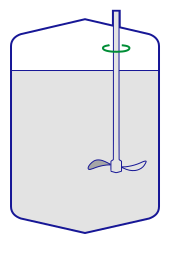
Propeller
Suitable for homogenising and suspending media with low viscosity. The flow pattern shows strong axial suction.
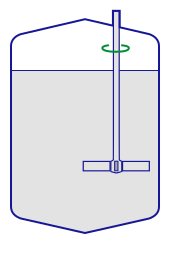
Straight blade
At higher speeds, the agitator provides a radial flow pattern and can create a vortex.
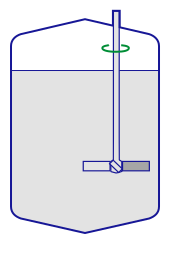
Slanted blade
The flow pattern is similar to the propeller. However, a stronger radial flow is formed compared to the propeller.
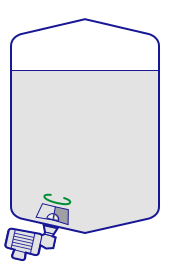
Bottom mixer
The bottom mixer is used when there is a lack of space on top or when stirring with a low minimum level.
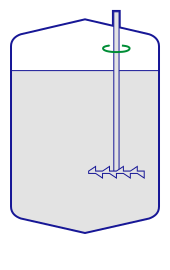
Saw blade
The agitator creates a high shear, which is why it is often used for mixing and dispersing powders in a liquid.
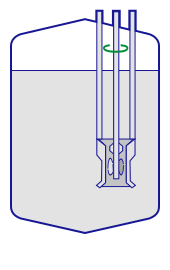
Rotor stator
The agitator consists of a rotor that rotates at high speed in a stationary stator. As the rotating blades pass by the stator, they push off the contents.
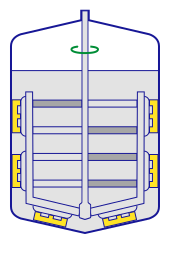
Fence agitator (with scrapers)
A slowly rotating agitator for temperature transfer and/or keeping the media homogeneous.
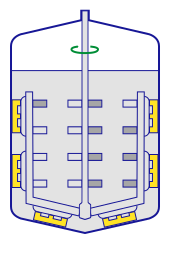
Anchor agitator (with scrapers)
For different processes in one tank, a dual agitator system can be applied by designing an anchor agitator.
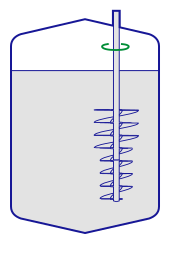
Screw agitator
The agitator provides a strong axial/tangential flow. This will push the media down or up.
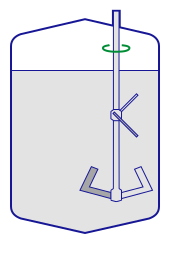
UZ agitator
The UZ agitator is used if a combination of mixing and homogenising a product that easily sags or is fairly viscous is required.
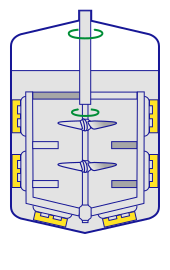
Coaxial agitator
It is specifically designed for mixing high-viscosity products, but can efficiently handle low-viscosity process stages. The agitator can perform a wide range of process tasks.